Rebalance Earth Podcast
Welcome to the Rebalance Earth podcast. We’re excited to introduce you to this new platform where we’ll explore innovative ideas, thought leadership, and the future of nature as an investible asset class.
Throughout this podcast, we’ll dive into the critical role nature plays in building resilient businesses, cities, and societies. Each episode will feature experts and leaders who are driving change in sustainability, finance, and climate innovation. Our mission is to challenge traditional business paradigms and shine a light on the opportunities to invest in nature.
So whether you’re an investor, a corporate leader, or just passionate about to make Nature an investible asset class, stay tuned for insightful conversations that can help us all rethink the future of business and nature.
Listen on:



Episodes

Thursday Jun 25, 2026
Thursday Jun 25, 2026
Zena Couppey left school at 16 with no degree, no female role models, and no blueprint. Today she runs Altum as CEO, having grown it from £11 billion to £72 billion in assets under six years, with a 60% female senior leadership team and Dame Helena Morrissey as chair.
This isn't a story about having it all figured out, but rather about what happens when you stop waiting for permission and get on with building the culture you wish you'd had. About making enough right calls under pressure, that eventually the numbers speak for themselves.
Kirsty and Zena talk about what authentic leadership actually looks like inside a fast-growing, PE-backed business. They dive into the AI transformation that's already underway, Altum's incredibly low staff turnover, and the very human cost of running a household with two CEOs, two children, and six offices across multiple continents. It's about discipline, leading with authenticity and creating the structures that allow people to thrive. When we create the space and support mechanisms for people to do their best work, we can therefore, as Zena puts it, focus on "winning together".

Sunday Jun 14, 2026
Sunday Jun 14, 2026
He helped build one of the most influential pensions and investment consulting firms in the UK.
Then he walked away from it.
In this episode of the Rebalance Earth Podcast, entrepreneur and bestselling author Daniel Priestley turns the tables and puts his long-time friend Rob Gardner in the hot seat.
The two have known each other for more than 15 years. Over that time they have both built successful businesses, navigated the realities of entrepreneurship, and seen firsthand what it takes to turn big ideas into companies that actually work.
But Rob’s latest venture may be the most ambitious yet.
Rebalance Earth is built around a simple but radical idea.
What if Nature wasn’t treated as a cost to be protected, but as infrastructure that investors can fund and earn returns from?
In this wide-ranging conversation, Dan pulls apart the origin story behind the company. Why Rob left a successful career helping shape institutional investment through Redington and managing billions of pounds of investments at St. James’s Place. What he saw at COP26 that convinced him the financial system was missing something fundamental. And why he believes the next major asset class could be nature itself.
They explore how restored landscapes can reduce flood risk for railways and cities and how pension funds are beginning to invest in ecosystems in the same way they once invested in renewable energy infrastructure.
But this conversation is also a deep dive into entrepreneurship.
About the moment you decide to leave a comfortable career and start again. About building teams, convincing sceptics, and turning a seemingly impossible idea into something that can actually work in the real world.
Because if Rob Gardner is right, the next generation of infrastructure will not be built from steel and concrete, but grown.
And the entrepreneurs who are able to figure out how to finance it will reshape the entire global economy.

Thursday Jun 04, 2026
Thursday Jun 04, 2026
Most decisions about nature risk are made without any data at all.
Right now, if you run a global supply chain, manage a pension portfolio, or sit on the board of a company with commodity exposure, the nature risk embedded in your operations is essentially invisible. The effects of yields declining, input costs rising and supply chains breaking being stretched is becoming more and more visible. But you can't price it, model it, or act to hedge against it.
In this episode, Rob Gardner sits down with Dimple Patel, CEO of NatureMetrics, a company that has spent a decade building the data infrastructure to change that.
Dimple explains how environmental DNA extracted from a bucket of water or a handful of soil can map every species in an ecosystem to forensic precision. That the tools being built for financial institutions today are deliberately slower to market than the technology allows, because the data has to be good enough to trade on. And what it would look like if nature risk appeared on a Bloomberg terminal the same way credit risk does now.
She's a former Goldman Sachs fixed income trader turned three-time entrepreneur, and she thinks about nature the way a portfolio manager thinks about exposure. She understands that with the right data presented in the right way, nature risk can be correctly priced and acted on in the financial markets.
It's an exciting conversation about what happens when the world stops flying blind on nature, and what the markets will look like when it can finally price what it's been ignoring.

Wednesday May 06, 2026
Wednesday May 06, 2026
Most people only think about water when it stops working.
But the story of UK water is far bigger, and far more broken, than those moments suggest.
£104 billion.
That's the investment committed to the UK water sector over the next five years. A system serving 70 million people, running on Victorian infrastructure, facing a reckoning it can no longer defer.
In this episode, Rob Gardner sits down with Chris Walters, CEO of Ofwat, the economic regulator at the centre of that transformation.
Chris explains why water bills stayed flat for two decades while the infrastructure fell behind. Why two thirds of what pollutes our rivers isn't domestic wastewater. And why the most serious thinkers in this space aren't reaching for concrete at all.
They're reaching for reed beds, wetlands, and restored river catchments.
It's a conversation about stewardship, natural infrastructure, and whether the next generation of essential systems gets built from pipes and tanks, or grown from the landscape itself.
If you've ever turned on a tap without thinking twice, this episode is worth your time. Water is a serious business.

Thursday Jan 22, 2026
Thursday Jan 22, 2026
He has spent his life studying risk.
From the trading floors of the City, to investment committees, to flood rescue teams pulling people from fast-rising water in the middle of the night.
Eoin Murray has seen what happens when systems fail. Financial systems. Natural systems. Human systems.
In this conversation, Eoin makes a stark case for why water will be the next major global crisis, and why almost nobody is paying enough attention.
As CIO at Rebalance Earth and a specialist in water rescue, Eoin sits at a rare intersection. He understands capital, climate, and catastrophe. He talks about floods not as abstract climate models, but as forces that humble even the most prepared teams. He explains why nature risk is already sitting on balance sheets, even if it is not yet priced in.
Drawing parallels with the build-up to the 2008 financial crisis, Eoin reflects on how over-reliance on backward-looking models blinds us to systemic risk. He argues that water scarcity, flooding, and food insecurity are not future threats, they are signals already flashing red.
Along the way, he shares what search and rescue has taught him about leadership, trust, and decision-making under pressure. Why the most experienced voice matters more than hierarchy. Why planning for failure is not pessimism, it is professionalism.
This is a conversation about water, yes. But it is also about responsibility. About what happens when we ignore warning signs. And about the uncomfortable question facing investors, governments, and all of us.
If we can already see the crisis coming, why are we still acting surprised?

Monday Dec 01, 2025
Monday Dec 01, 2025
He walked away from one of the safest careers in finance to build something the world had never seen before.
A way to make nature an investable asset class.
Robert Gardner, co founder and CEO of Rebalance Earth, has spent two decades at the intersection of money, purpose, and systems change. In this candid conversation, he explains why he left the FTSE 100 track, not once but twice, to tackle the climate and nature crisis head on.
From the trading floors of Deutsche Bank to founding Redington in a two room office, to his most recent startup in Rebalance Earth, Rob shares the moments that shaped him. He describes the mentors who pushed him, the first believers who backed him, and the purpose that now powers his boundless energy.
Rob talks about what it takes to build movements that people once called “crazy”, why purpose is a superpower, and how the UK could become the world leader in nature based resilience.
It all comes back to one question. "Will I be able to look my daughters in the eye in 15 years and say I did everything I could?"
This is a conversation about risk, reinvention, and the relentless pursuit of a world worth living in.

Tuesday Oct 21, 2025
Tuesday Oct 21, 2025
He swam across the North Pole, through water colder than where the Titanic sank, to deliver one message to world leaders about our planet’s future.
Lewis Pugh, UN Patron of the Oceans, is one of the world’s most extraordinary endurance swimmers. In this Season 2 premiere of The Rebalance Earth Podcast, he shares what drove him to swim in –1.7°C water, and how that moment changed his life.
From the Arctic to the UN, Lewis explains what he’s witnessed beneath the surface: collapsing ecosystems, melting glaciers, and a future we can still protect... if we act now.
This is a conversation about courage, leadership, and the limits of endurance, both human and planetary.
Thursday May 01, 2025
Thursday May 01, 2025
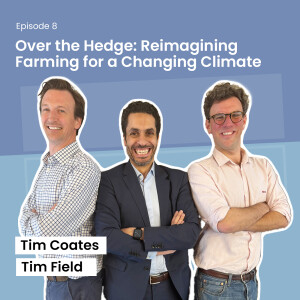
Join us for a captivating conversation with Tim Coates and Tim Field, the visionary farmers behind the Northeast Cotswold Farmer Cluster - a groundbreaking collaboration that's transforming how farmers work together to build resilience in a changing climate. From 10 farms to over 170, discover how this farmer-led movement is pioneering nature-based solutions that benefit both agricultural productivity and the wider environment.
In this eye-opening episode, our guests share:
How collaborative farming at landscape scale creates solutions traditional approaches can't achieve
The business case for nature-based solutions that protect farms from flooding and drought
Why "re-wiggling" rivers and creating healthy soils acts as natural infrastructure
How infrastructure companies like Network Rail are investing in farm-based solutions that are 10x more cost-effective than concrete alternatives
The journey from post-WWII "maximize production" mindset to today's integrated ecosystem approach
Practical ways farmers are turning climate challenges into opportunities
Don't miss this inspiring discussion that offers a practical blueprint for how farmers can lead the transition to a more resilient landscape while maintaining productivity. Whether you're a farmer, landowner, investor, or simply concerned about climate resilience, this episode provides valuable insights into the future of sustainable land management.
👍 If you enjoyed this episode, please like, comment, and subscribe for more insights on sustainable finance and nature-based solutions!
Discover more from the team: https://www.rebalance.earth/
#RegenerativeFarming #NatureBasedSolutions #ClimateResilience #Collaboration #SustainableAgriculture #Cotswolds
Monday Mar 24, 2025
Monday Mar 24, 2025
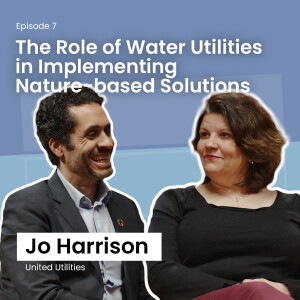
In this episode, we are joined by Jo Harrison, Strategic Planning Director at United Utilities, as she shares how one of the UK's largest water companies is pioneering innovative approaches to water management. Discover how nature-based solutions are transforming the water industry's response to climate change, urban growth, and environmental challenges.
In this fascinating episode, Jo reveals:
How United Utilities is breaking down silos between flood management, water quality, and resource planning
The success stories behind groundbreaking projects in the Petteril and Wyre catchments
Why working with farmers, local communities, and unexpected partners like Nestlé creates powerful environmental markets
The business case for choosing green infrastructure over traditional "grey" engineering solutions
United Utilities' vision for valuing "every drop that falls" through nature-based approaches
Don't miss this inspiring discussion on how innovative thinking and cross-sector collaboration are transforming water management for a more resilient future. Whether you're interested in sustainability, infrastructure planning, or nature-based solutions, this episode offers valuable insights into creating climate-resilient communities.
Subscribe for more thought-provoking conversations on sustainability, finance, and innovative solutions to our global challenges.
Discover more from the team: https://www.rebalance.earth/
Friday Mar 07, 2025
Friday Mar 07, 2025
International Women's Day Special:
Career Conversations with Kirsty & Liberty
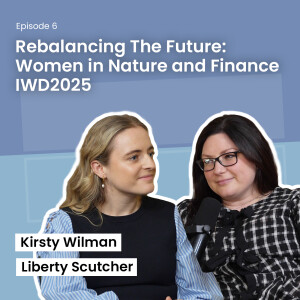
In this special International Women's Day episode of the Rebalance Earth podcast, COO Kirsty Wilman sits down with Investment Analyst Liberty Scutcher for an inspiring conversation about careers, confidence, and navigating professional life as a woman. From early career challenges to finding balance, this candid discussion offers valuable insights for professionals at all stages.
KEY INSIGHTS:
💡 "There's no such thing as imposter syndrome. It's the inside catching up with the outside." - Changing perspective on self-doubt
💡 Cultural change is more important than rule changes when creating inclusive workplaces
💡 Finding your authentic style is more effective than trying to copy others
💡 Women often hesitate to apply for roles unless they meet 100% of qualifications, while men apply with far fewer
💡 Taking on challenges that make you nervous is essential for professional growth
💡 Strategic career planning and viewing yourself as an asset to develop can accelerate your professional journey
💡 Work-life balance is essential for long-term success and happiness in your career
Follow Rebalance Earth for more insights on sustainability, investing, and professional development!